
During my studies in Barcelona from 1994 to 1996, I met the conductor Jordi Mora teaching chamber music. He introduced me to a phenomenological understanding of music that he himself had studied with the Romanian conductor Sergiú Celibidache. This became a life-changing encounter for me, where I experienced coming “inside the music” in a way I had never experienced before.
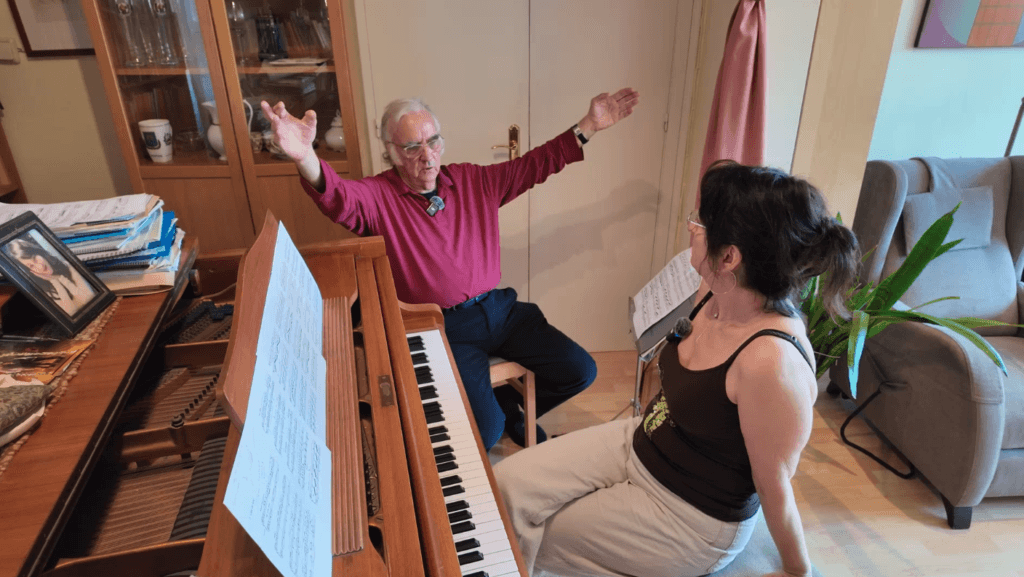
Videos will soon be available from this page
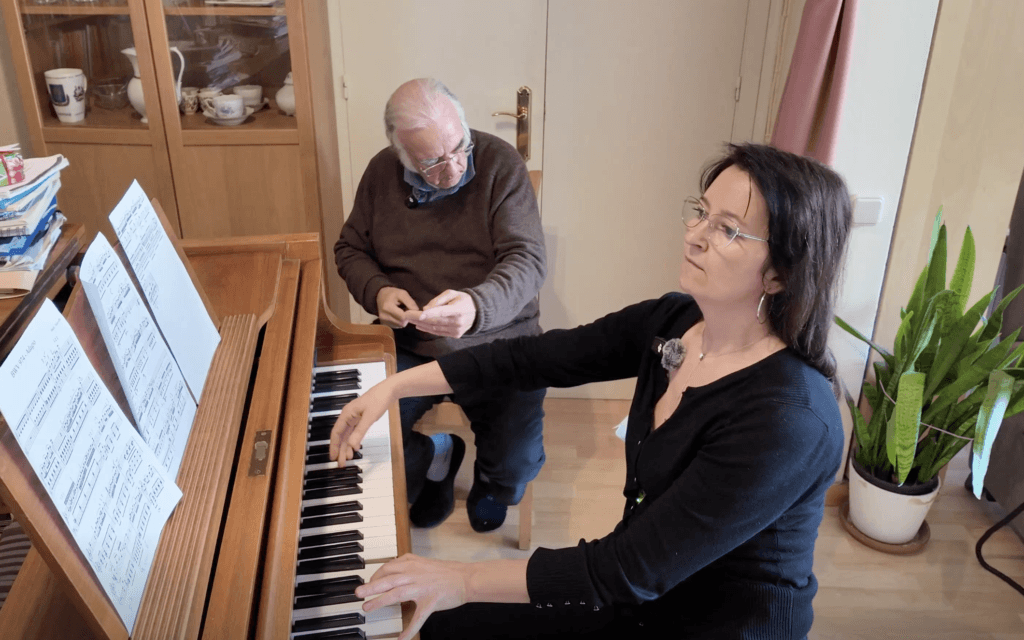
I have remained in contact with Jordi Mora ever since, and Lyttelos grows directly out of this knowledge and way of listening. Because this is a living and experience-based form of knowledge that is difficult to capture within a fixed system or method, I have in recent years begun documenting and sharing this oral tradition through video recordings and podcasts together with him.
Jordi Mora emerges not only as an outstanding musician and pedagog, but as a rare musical thinker who guides others toward the lived essence of music itself. His work reveals a deeply phenomenological understanding of musical experience: music is not treated as an object to be executed, but as a living phenomenon that arises through listening, resonance, time, space, breath, and consciousness.
In his teaching, Mora goes far beyond traditional musical understanding. He focuses not primarily on stylistic correctness or external expression. Instead, he leads us into the inner conditions through which musical meaning can emerge. Tempo is not mechanical pulse, but something that grows out of the resonance of sound itself. Dynamics are not merely volume, but states of atmosphere, distance, and presence. Harmony is experienced as tension, suspension, opening, return, introversion, and release.
What makes Jordi Mora unique is his extraordinary ability to unite:
- deep structural understanding of music
- refined listening
- philosophical insight
- and musical practice
He constantly reveals connections between composers who are often presented as opposites. For Mora, there is no essential difference between Johann Sebastian Bach and Claude Debussy:
“Languages are as many as the composers. Essence is one.”
This expresses a rare artistic vision: beneath stylistic differences there exists a universal human musical essence. Whether Gregorian chant, Bach, Debussy, jazz, or folk music, Mora searches for the fundamental principles of living musical meaning.
His pedagogy also clearly bears the influence of Sergiu Celibidache, yet Mora’s voice remains entirely personal — warm, poetic, uncompromising, precise, and deeply humane.
Perhaps most remarkable is the way Mora transforms teaching into an awakening of perception. Even silence becomes meaningful:
“In the end, silence is also music.”
His teaching opens not only the structure of the score, but also the deeper experience of what it means to listen, to experience time, and to encounter beauty. This is why Jordi Mora stands as such an extraordinary figure in today’s musical world. In an age often dominated by musicians seeking to express themselves rather than listening deeply to the music itself, he reminds us that music, in its deepest essence, is an art form concerned with consciousness, relationship, and human presence.